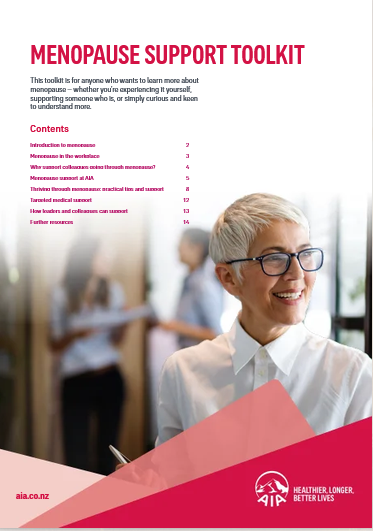




AIA New Zealand has released an expanded version of its Menopause Support Toolkit, which offers practical approaches organisations can adapt “to help employees navigate perimenopause, menopause and post-menopause while remaining engaged and thriving at work”.

The insurer says the toolkit, which was originally launched in 2021 and made publicly available, has helped spark conversations about workplace menopause support both within AIA and across other organisations in New Zealand.
It says the updated resource, released to mark Tend Women’s Health Week, builds on that foundation, bringing together practical guidance, workplace support tools and wellbeing resources in one place.

The refreshed toolkit comes as research highlights the impact menopause can have on workplace participation and productivity, and at a time when New Zealand’s workforce is getting older.
AIA NZ says NZIER research undertaken for Global Women [in 2023] found workplace conditions play an important role in supporting women to remain engaged in work during menopause, and that some women reduce their hours or leave work altogether when the adjustments they need are not available. From this research:
- 73% say menopause affects them at work
- One in five have considered leaving work because of it
- Only 22% have spoken to their manager about it
The company adds that workers in New Zealand aged 50 and over make up a growing proportion of the labour force and represent one of the country’s fastest-growing workforce demographics.
At AIA NZ, 63% of employees are women and nearly half are aged between 40 and 60, the years when many people experience perimenopause and menopause.
Brynlea Hunter-Morpeth, AIA NZ’s Chief People Officer, says not having a menopause framework to support employees could negatively affect organisations at a time when their focus should be on the retention of skilled people.
…Women in their 40s and 50s are often at the height of their careers…
“Women in their 40s and 50s are often at the height of their careers. They’re leading teams, mentoring colleagues, building expertise and making significant contributions to their organisations.
“At a time when many industries are focused on attracting and retaining experienced talent, employers can’t afford to overlook menopause as a workplace issue.”
She says national conversations around productivity and New Zealand’s workforce should include greater awareness of possible impacts of menopause.
“Nationally there’s a lot of discourse about productivity and future-proofing our workforce, and the challenges that may be pushing experienced women out, or preventing them from performing at their best, need to be part of that conversation.”
…supporting women through menopause isn’t complicated…
She hopes the refreshed toolkit highlights that there are simple and practical adjustments organisations can use and adapt, adding that supporting women through menopause isn’t complicated, but failing to do so comes at a cost for individuals, workplaces and the wider economy.
Click here to see the toolkit.