
New Zealand needs to make a step change in financial resilience, findings from the Financial Services Council’s latest Financial Resilience Index show, pointing to an opportunity to help New Zealanders move from “coping to confident”.

FSC Chief Executive Kirk Hope says that means “…helping people build good habits earlier, get better support when decisions matter, and have the right tools in place before life throws them a curve-ball.”

“KiwiSaver, health and life insurance and financial advice all have a role to play. Done well, they help people plan ahead, manage shocks and feel more in control of their future. That is where the financial services sector can make a real difference to people’s lives,” he says.
Now in its seventh year the Index found New Zealanders feel more capable with money, but the pressure is still hitting their health, relationships and short-term resilience.
The council says New Zealanders are becoming more confident making financial decisions, with 90% of respondents saying they are at least reasonably confident, up from 84% in 2025.
It says self-reported financial literacy has also improved across key investment concepts, including risk and return, diversification and asset allocation.
“However, improved confidence and literacy are not translating evenly into action. KiwiSaver remains the most common investment type, held by 75% of respondents, but has softened from 81% in 2025.”
Hope says the findings show those pressures are being felt in everyday life, with 65% of New Zealanders worrying about money at least monthly, rising to 76% among Gen Z respondents.
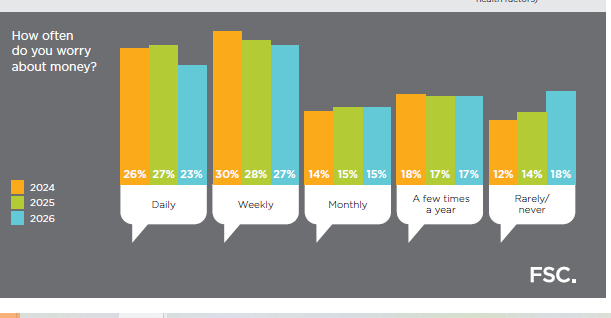
“Money worries remain a regular part of life for many Kiwis, and younger people are feeling that most acutely. That matters because these are the years when people are often trying to build savings habits, start investing and lay the foundations for long-term financial security.”
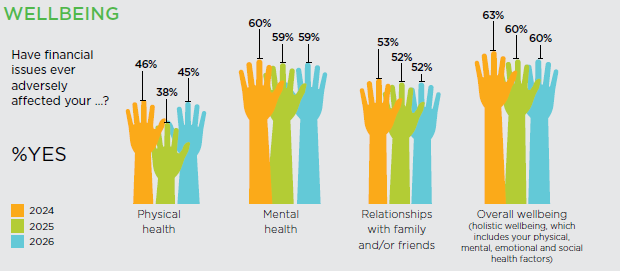
This is also flowing through to New Zealanders’ health and relationships, with 59% saying financial issues have affected their mental health, half (52%) saying relationships with family and friends have been impacted, and 45% saying their physical health has been affected.
“When money worries begin affecting people’s health, relationships and quality of life, this no longer just a household budgeting issue. It is a resilience issue for New Zealand,” Hope says.
The Index points to a growing confidence gap with New Zealanders feeling more capable managing their own money, but less certain about the economy around them.
While personal financial confidence has reached its highest level in recent years, almost half of respondents (47%) say they feel somewhat or very unconfident about overall economic conditions, with inflation remaining the top financial concern, according to the report.
“New Zealanders are learning to live with uncertainty. The challenge now is helping people turn that confidence into stronger financial resilience, so they can plan, manage shocks and thrive despite economic uncertainty,” says Hope.
Half (52%) of respondents feel very, or reasonably, financially prepared for retirement, but short-term resilience remains a concern.
“Around one in two (55%) New Zealanders say they could access $5,000 within a week for an unexpected expense without going into debt, a figure that has remained unchanged for the past three years. Respondents reported that household investments have also declined across most of the savings bands, with the lower levels of savings showing an 8% drop in $50,000 or less in savings and an additional 14% for those with $150,000 or less.